The impact of city walls on urban expansion and structure of small historical cities: a Space Syntax analysis of Zhengding, China
November 2025
Historic city
Urban heritage
Urban segregation
- Qian Liu , First author , Politecnico di Milano
- Gerardo Semprebon , Politecnico di Milano
- Kun Li , Kun Li , Xi’an University of Architecture and Technology
Type
Journal
Journal
Journal of Asian Architecture and Building Engineering, 2025
Abstract
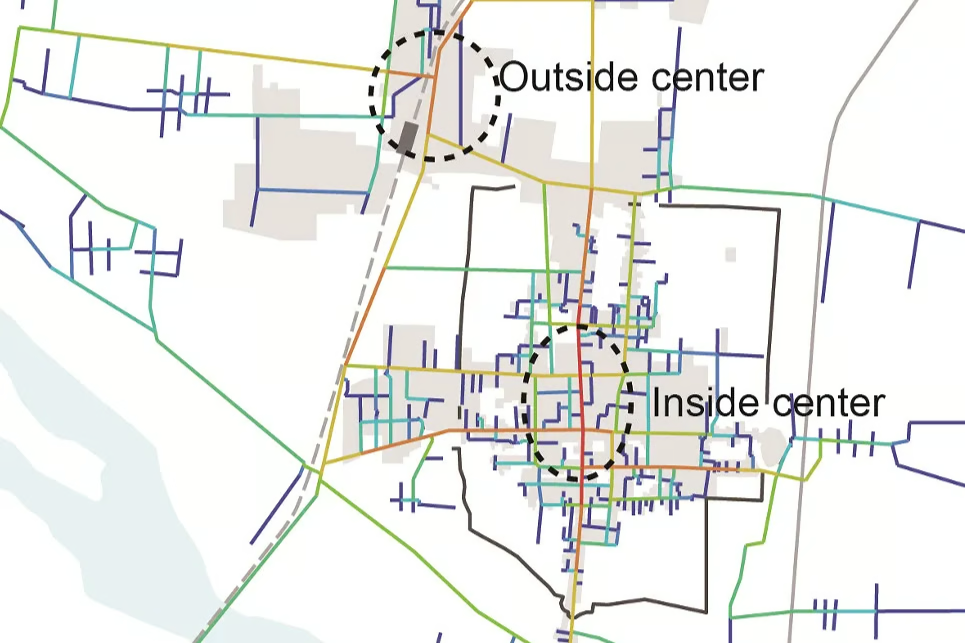
This study employs Space Syntax analysis to examine the urban expansion of Zhengding, a small historical city in northern China. Focusing on the impact of the city walls on urban form, spatial connectivity, and functional distribution, the research analyzes the city’s growth at four key stages (1966, 1992, 2008, and 2024). The findings reveal a complex and evolving impact by the city walls, beyond that of a simple constraint. First, the walls mediated a unique “overflow before filled” expansion pattern, where partial demolitions guided expansion outward before the inner city was fully developed. Second, contradicting existing research, the city’s Axial Synergy increased over time, revealing the walls’ previously unappreciated function as a “stabilizer”. Finally, the walls’ impact is highly differentiated, creating divergent development logics inside and outside the city, as evidenced by the varying correlation between syntactic measurements and the distribution of commercial POIs. This study offers a refined methodological framework for analyzing the spatial structure of small historical cities and the impact of physical boundaries, providing insights for planning and heritage preservation policy, particularly on balancing development and heritage preservation.
Keywords
City walls; Space syntax; Urban growth; Historical cities; POIs analysis; Zhengding
Author contribution
- Qian Liu conceived and designed the research, collected data, performed the space syntax analysis, and drafted the manuscript.
- Gerardo Semprebon participated in the analysis and interpretation of results and revised the manuscript.
- Kun Li contributed to the research concept, supervised the research and critically revised the manuscript.
主要图表
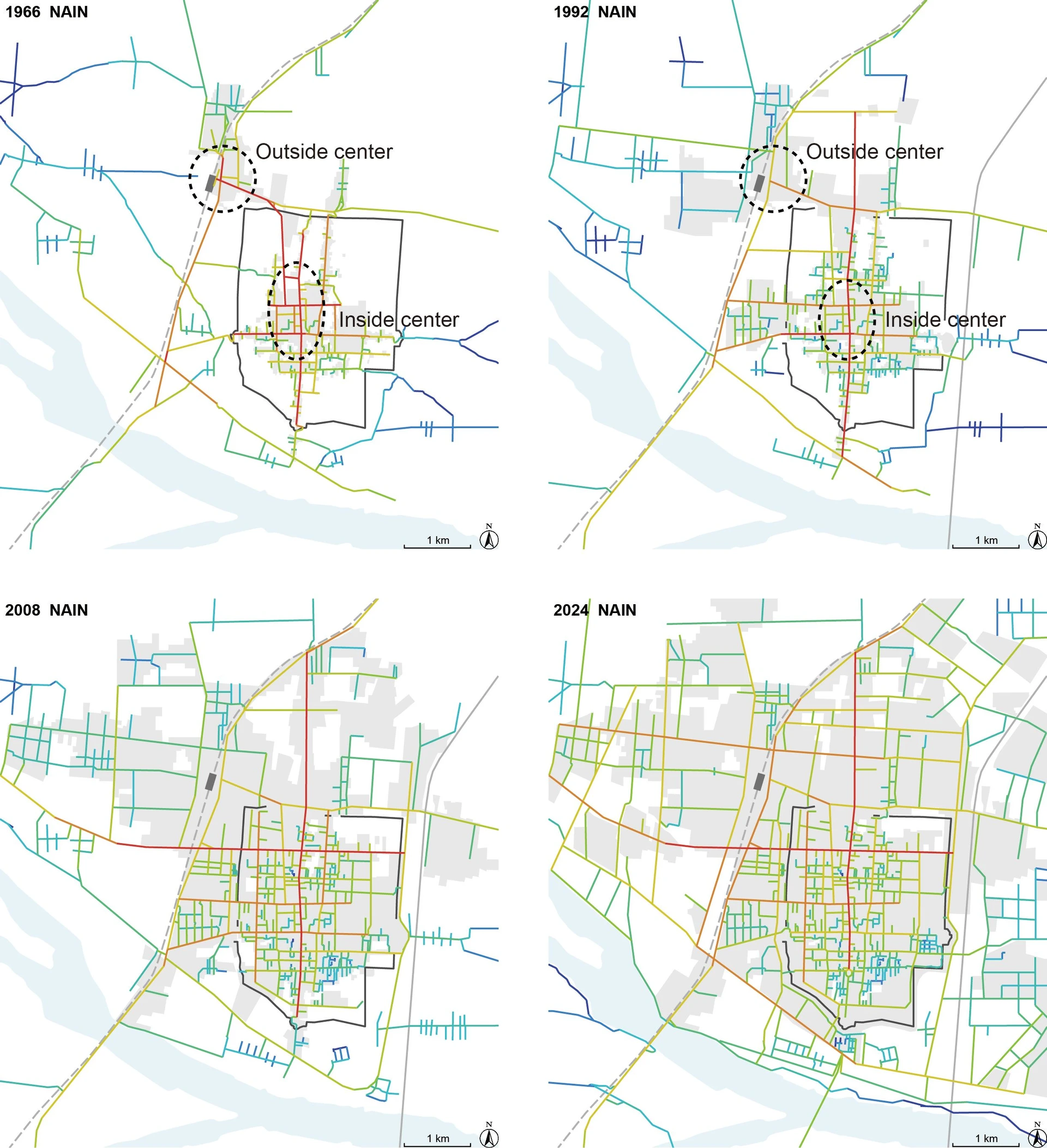
The results of NAIN (Normalized Angular Integration) analysis on Zhengding in 1966, 1992, 2008, and 2024, with the built-up area illustrated with gray in the background. Source: the authors, 2024.
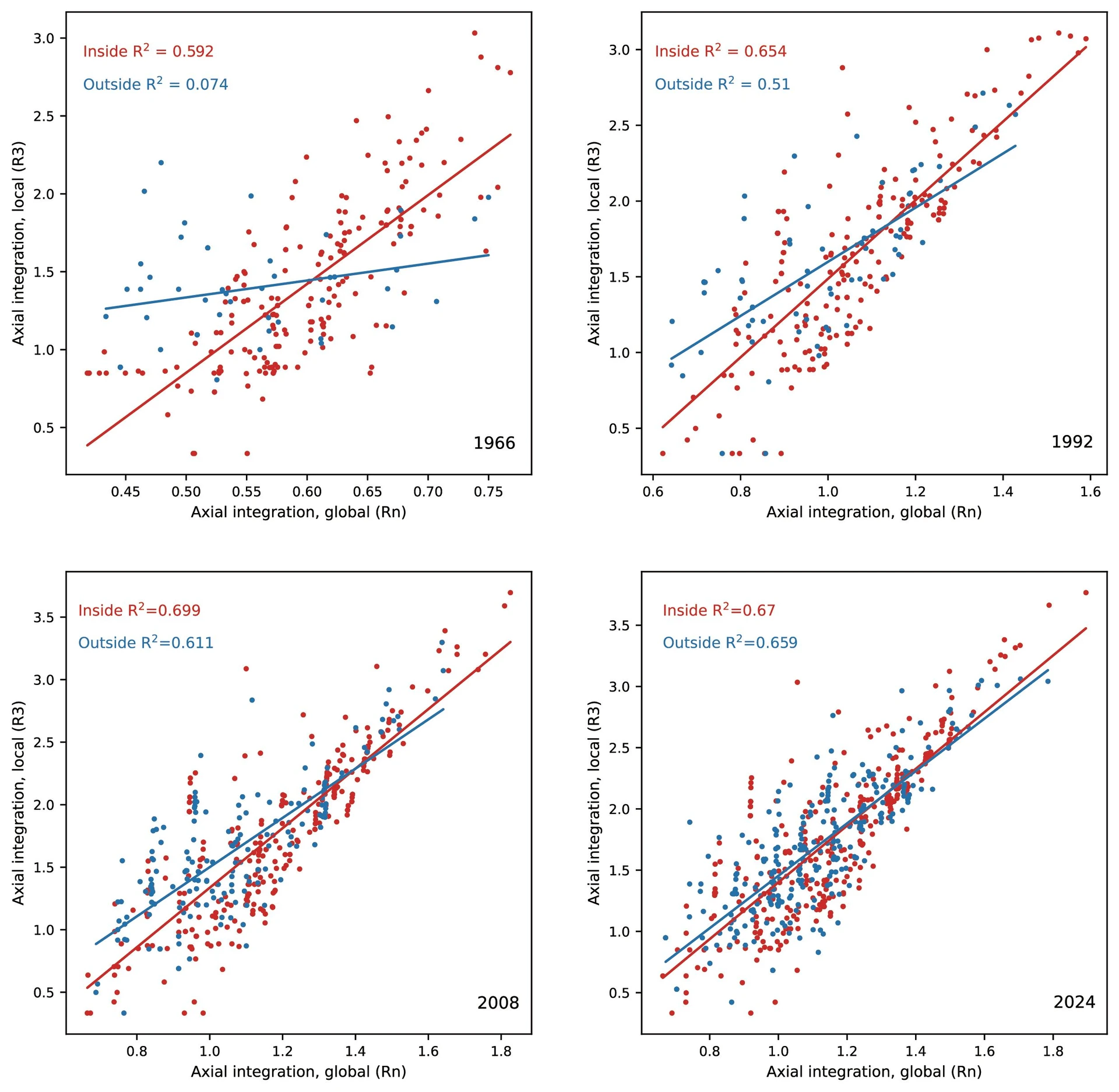
Scatter plots and regression analysis between radius-3 and radius-n integration values of Zhengding across different years. Source: the authors, 2024.