Role of public spaces between built heritage and living city: the case of Changle Gate in Zhengding, China
2022年7月
历史城市
公共空间
城市遗产
- 刘乾 , 第一作者 , Politecnico di Milano (米兰理工大学)
- Laura Pezzetti , Politecnico di Milano (米兰理工大学)
文献类型
会议
发表于
34th AESOP Annual Congress 2022 (第34届欧洲规划院校联合会年会2022)
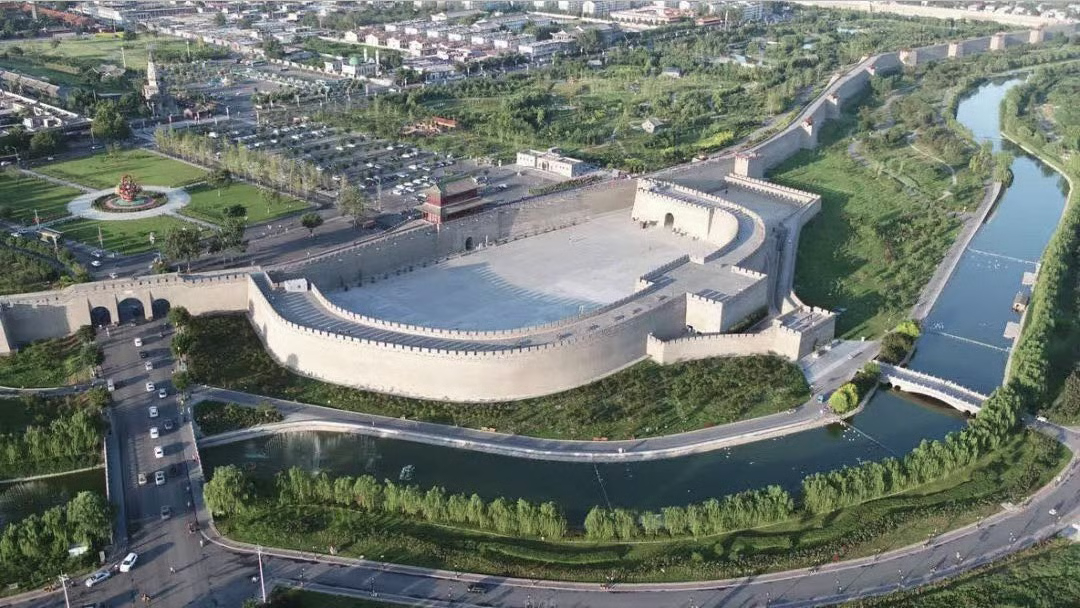
Changle Gate, aerial photo, provided by Zhengding Bureau of Culture and Tourism
摘要
Public spaces are ‘stages upon which the drama of communal life unfolds’ (Carr et al., 1992). They stimulate communication and integration among people of different social classes and groups. Their interaction with public life help establish connections between human beings and the urban environment. Thus, public spaces are endowed with cultural and emotional meanings, becoming the essential element of shaping and manifesting local identity (Čamprag, 2017).In historic cities, public spaces support memories and stimulate contemporary urban life, which is crucial to perceiving and enjoying the historic urban landscape (Pezzetti, 2019). Public spaces and built heritage in the layered morphology of historic cities together form ‘a correlated entirety that can be read and designed as a unique palimpsest’ (Pezzetti, 2017), providing opportunities for contemporary interventions. Such interventions are always subject to two extremes, one is the continuity that preservation imposes, and the other is the necessary changes as responses to development (Čamprag, 2017). Interventions compromising between these two extremes inevitably involve a voluntary ‘filtering’ of the historic city, powered by various agendas and interests.These interventions and ‘filtering’ should be based on sufficient knowledge of the pre-existing urban structure and texture and fully involve public life. This way, they will be able to enhance the correlated entirety into a regenerative structure that eventually integrates built heritages into the contemporary living city (Pezzetti, 2017).Unfortunately, not all interventions were carried out in this way. Built heritage and historic cities are no longer merely cultural or historical objects in the increasingly affluent and leisure-oriented contemporary Chinese society. Still, they are also regarded as resources for city development strategies, especially tourism. The authority of ‘filtering’ that decides what to preserve has thus been taken over by the powerful tourism industry and the political force that collaborates with it (Čamprag, 2017), who also have replaced public life to dominate the production of Public spaces around built heritage (Chen, 2018). Built heritage sites and the past and memory they are carrying are used as symbols to create ‘themed’ public space, i.e., create an ambience of a fantasy that could stimulate activities and consumption (van Melik et al., 2007). Instead of being the link between built heritage and the living city, such themed public spaces tend to create an estranged and self-contained unit (Liu and Pezzetti, 2022) with the built heritage at its centre, refusing to interact with the rest of the city.This paper focused on the built heritage of Changle Gate in Zhengding and its surrounding area, which have recently undergone tourism-oriented re-development. The role of the newly produced public spaces between Changle Gate and the city of Zhengding and their potential impact on the city is analysed.
关键词
Public spaces; Built heritage, Zhengding; China; Changle Gate; tourism
会议信息
本文以口头报告的形式于 第34届欧洲规划院校联合会(AESOP)年会 进行展示,并收录于会议论文集;会议主题为 “Space for Species: Redefining Spatial Justice”,于2022年7月25日至29日在爱沙尼亚塔尔图举行。
永久链接
https://hdl.handle.net/20.500.14235/175
作者贡献
- 刘乾构思了本项研究,收集了资料,绘制了图纸,并撰写了主要文稿。
- Laura Pezzetti 指导了本项研究,并对文稿进行了审阅修订。
主要图表
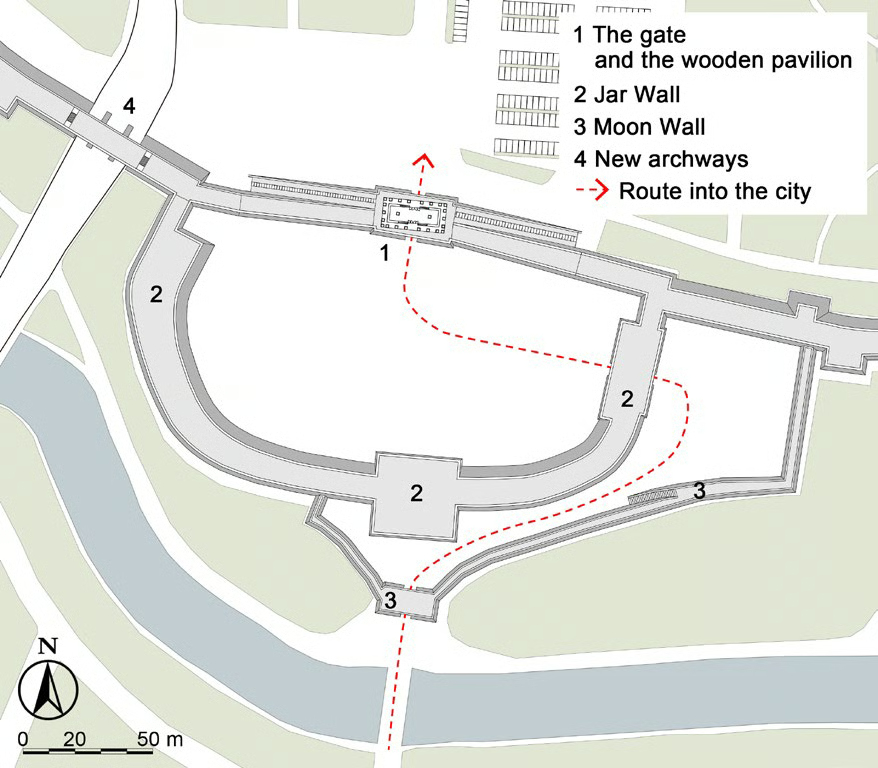
长乐门,2013-2019年修复工程后的平面
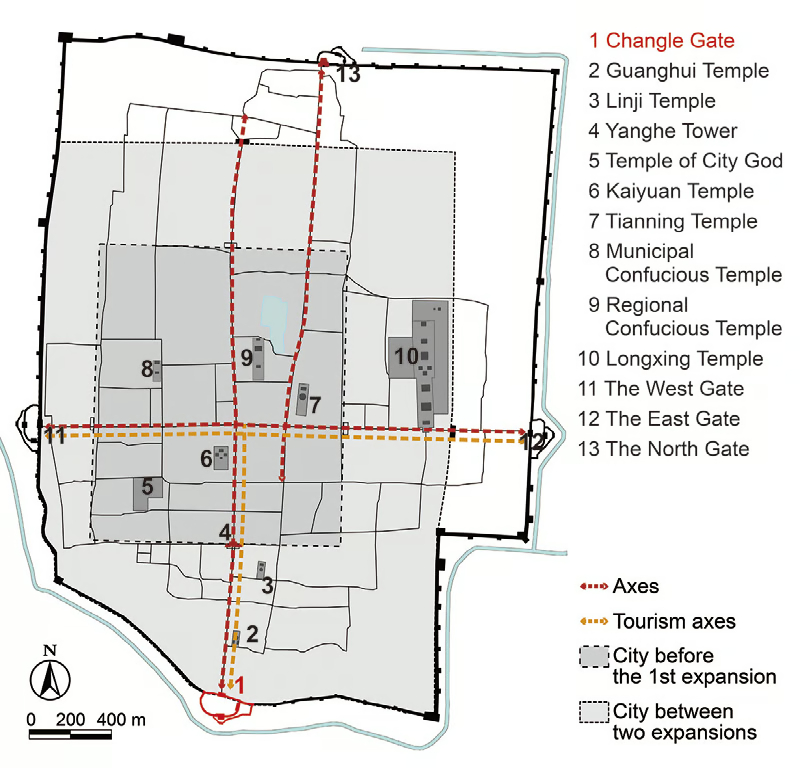
正定城在历史上的三次扩张